Memos

Provost’s Message: A View into the In-Person Experience

Dear UConn Faculty, Staff, and Graduate Students:

In just a few more weeks, we start a fall semester that looks different from any other year. Much of our instruction will take place through virtual and remote means; however, about 30% of fall semester classes will be conducted in person.

For our instructors, students, and staff who will be on our campuses when we reopen, I want to assure you that individuals and teams across the University have been working tirelessly to create as safe an environment as possible. This has involved several offices, including Facilities Operations, Student Affairs, UConn Health, Student Health and Wellness, University Communications, Human Resources, Dining Services, Residential Life, Public Safety, University Planning, Design and Construction, and dean and department offices.

Our re-entry into the fall starts with a commitment to the safety of ourselves and our colleagues. The University has created the UConn Promise, which promotes behaviors among our community members to maintain a safe and respectful environment. The UConn Promise includes committing to public health measures such as wearing masks, as well as encouraging Huskies to look out for one another, especially as COVID-19 has been coupled with heightened discrimination for some of our faculty, staff, and students. We started by asking our undergraduate students to make this promise. We now ask all faculty, staff, and graduate students to review the promise and make a commitment to follow these guidelines to promote the well-being of our community.

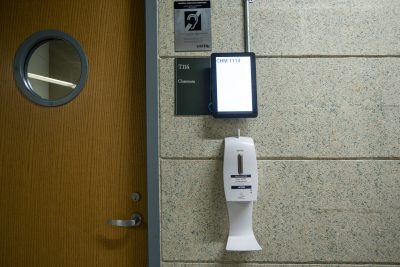
Hand sanitizer dispenser at the Chemistry Building

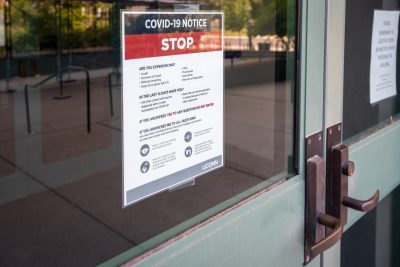
Covid 19 sign at the Chemistry Building

The other key safety factor concerns the physical spaces we will share on our campuses. I want to give you a view into what several aspects of the UConn in-person experience will look like in Storrs and all the regional campuses.

Before even stepping inside any building, you will see a sign enforcing mask usage, hygiene and social distancing protocols, and symptom checking. Once in any building, you will find multiple hand sanitizer dispensers in hallways, with prominent signage to alert Facilities staff when refills are needed. Additional signage will be posted throughout buildings with guidance on social distancing, hygiene, and other public health protocols.

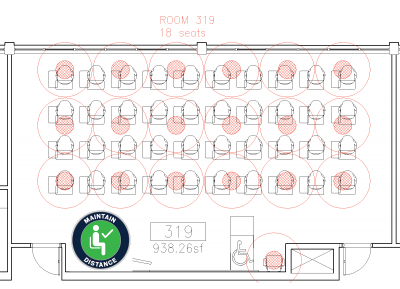
Classroom layout for social distancing

In each classroom, the seating layout has been analyzed and rearranged for social distancing. Layouts for classrooms, teaching labs, and other facilities are available to view and download at this Sharepoint site from University Space Planning and Management. In some cases, the new layouts have reduced classroom capacity by up to 80%. In each room, green stickers will be affixed at seats to show where students can sit. It is important that students and instructors follow these guides to maintain safe distancing in the classroom.

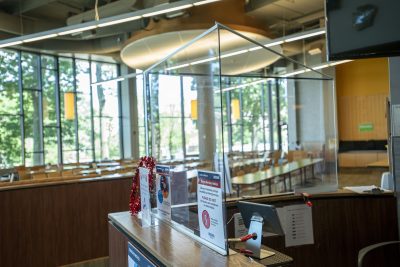
High-touch surfaces such as door handles, railings, and bathroom surfaces will be cleaned regularly throughout the day. Classrooms will be cleaned twice daily, and cleaning supplies will be available in each room for faculty and students to clean shared equipment and seating upon entry and exit to classrooms. High-traffic entry and exit points will be marked as “enter only” and “exit only” to minimize close physical contact. Plexiglass shields have been installed in high-traffic areas, such as dining halls and service counters—both as part of the plan put together by Facilities Operations as well as by request from staff working in those spaces.

Example of a Plexiglass shield at McMahon Dining Hall

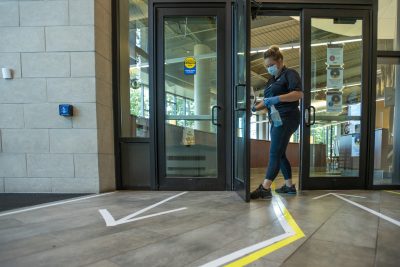
Custodian sanitizing door handles

We have created an FAQ as a resource to find these details and others relevant to academic scenarios at https://provost.uconn.edu/covid-19-fall-planning/covid-19-faqs-for-instruction/. Most of these are based on questions we have received from faculty, staff, and students, so please continue to share those with us. We will add to this list regularly.

Our preparations for the fall semester are focused on creating distance and, at the same time, grounded in community. I am encouraged by the care everyone has shown under exceptional circumstances to create an environment for our students, faculty, and staff that puts well-being first. This is in addition to the work I’ve seen so many of you doing to ensure an exceptional academic experience for students, as you prepare for different modes of instruction, advise students for the fall, and retool programs and processes for remote operations or limited in-person settings. Your efforts are appreciated at every level.

Thank you,
Carl

Carl Lejuez
Provost and Executive Vice President for Academic Affairs

Updates for the Academic Community

CETL Resources for Fall Teaching Preparation

This message is sent to all UConn faculty and graduate students on behalf of Peter Diplock, Associate Vice Provost of the Center for Excellence in Teaching and Learning.

Dear Colleagues,

I hope this communication finds you well and looking forward to the start of a new academic year!

I am reaching out to provide a CETL perspective on the state of teaching preparedness and to provide additional resources for your consideration. The list below provides a selection of curated highlights for your consideration.

I also thought it might be useful for you to have a sense of the collective university-wide effort to prepare for an unprecedented fall semester, and the unparalleled level of commitment demonstrated by our faculty and graduate TA instructors to acquire the knowledge and skills necessary to be effective in the multi-modal teaching and learning COVID-19 environment.

In the last six weeks we have seen more than 700 faculty and graduate TA instructors complete the week-long Preparing for Distance Education course.  In the last four months we have seen 7,000 registrations from more than 2,200 individuals across all CETL teaching and educational technology workshops.  There have also been many faculty and graduate TA instructors-led, department level, and school/college wide initiatives to address unique discipline specific or context specific (i.e. lab, performance, field-based, and clinical courses) challenges.  And, there is still time for additional training in the next few weeks as we plan to continue to offer our most popular workshops and 30 minute one on one consultations for more focused needs.

Sincerely,

Peter

Peter Diplock, PhD
Associate Vice Provost
Center for Excellence in Teaching and Learning
University of Connecticut
Storrs, CT

860-486-2915 (Direct)


Resources for Fall Semester Teaching Preparation

  • HuskyCT
    • Every lecture and discussion course this fall semester has a HuskyCT course site already created.  If you need HuskyCT assistance for your course please contact edtech@uconn.edu or attend one of the many workshops being offered in August.
  • Syllabi resources
    • Faculty and graduate TA instructors should review fall 2020 draft language for syllabi in this shared Google doc from CETL available for all instructors to use as a template
    • Faculty and graduate TA instructors should post and display their syllabus in their HuskyCT course site
    • Faculty and graduate TA instructors are also encouraged to provide a link to their syllabus in StudentAdmin by filling out this form: https://ecampus.uconn.edu/syllabuslink/
  • Student communication/engagement
    • Creating engaging instruction, meaningful work, a sense of classroom community, and structure are critical whether the class be in person, hybrid, or remote.  Learn about student desires for courses in this recent article, What Incoming First-Year Students Want Online Learning to Be or schedule an appointment with CETL staff to develop strategies for your course.
    • Faculty and graduate TA instructors teaching online and distance learning are encouraged to find ways to engage and connect with students, and promote active student-to-student interactions early in the semester to promote student feelings of engagement and connectedness. Starting the semester remotely and teaching online for the entire semester will require innovative approaches that sustain student motivation.
    • Faculty and graduate TA instructors should specify and clarify office hour protocols and their availability to meet with students.
    • Faculty and graduate TA instructors are encouraged to email their students, open their HuskyCT site early, or take other measures to assist their students in understanding what their course structure will be prior to the start of the semester. The structure of each course will be unique this fall and providing students with information earlier will assist them in preparing effectively.
    • All faculty and graduate TA instructors should develop a strategy to engage students who will not be able to attend class because of illness.  This includes utilizing Kaltura lecture capture to record and then upload lectures. If you need training on Kaltura, please register for a workshop at https://fins.uconn.edu/upcoming_workshops.php
  • Accessibility:
    • Although ideally all video content should be captioned, video content on a password-protected site, such as HuskyCT, is not required to be captioned unless the faculty or graduate TA instructor is notified by the Center for Students with Disabilities.
    • Captioning is available for any video through Kaltura but it is critical for faculty and graduate TA instructors to review and correct the captioning to ensure accuracy.
    • ITS also offers a fee for service captioning option
  • Assessment
    • Faculty and graduate TA instructors are encouraged to develop a thoughtful assessment strategy aligned with their learning objectives and teaching modality.  This includes remote assessment methods throughout the semester, and all final assessments which will be remote after the Thanksgiving recess.  Workshops are offered that explore alternative assessment strategies and methods.
  • Technology
    • ITS has made recommendations on minimum technology requirements. If faculty and graduate TA instructors need laptops, headsets, or microphones, ITS recommends reaching out to your department IT staff and they will coordinate with ITS.
    • Be prepared for equipment and technical issues and tell students what the back-up plan is if lecture capture, recording, synchronous class time, etc. do not work out as planned.
  • COVID-19 considerations
    • Acknowledge to yourself and to your students that these are difficult times. Be sensitive to student circumstances and learning environments. Work to reduce your own and your students’ stress and improve mental health.
    • All faculty and graduate TA instructors should prepare for the possibility that the university may return to entirely remote learning at some point in the semester if public health conditions deteriorate significantly. Faculty and graduate TA instructors should have a back-up plan for completing the semester, which ensures continued structure, student engagement, and community in case this should occur.
    • All courses will be taught remotely following the Thanksgiving recess.  Faculty and graduate TA instructors should be planning for how to continue to teach during this remote period and sharing that plan with students as soon as possible.
    • Faculty and graduate TA instructors should develop contingency plans to put in place should they get ill or test positive for COVID-19 during the semester (e.g. use the buddy system to identify a colleague who is aware of the syllabus and course plan and could step in and help support if needed).
  • Distance Learning (DL) tips and reminders
    • If you are teaching synchronously, make sure to record all lectures. This can be done whether using Webex or Collaborate.
    • Be sensitive to possible time differences. You may have international students enrolled in your classes. For example, students in China have a 12-hour time difference.
    • If you plan to administer exams please do so during the time allotted for your course in StudentAdmin/Peoplesoft.  Moving exams outside your scheduled class time can create time conflicts for students.
    • Consider coming to campus to utilize technology in the classrooms to teach from. Please follow the University mandates for testing and be sure to reserve a classroom for your desired time.
    • CETL continues to offer their Preparing for Distance Education course if you need guidance on course planning. To register: https://fins.uconn.edu/upcoming_certificates.php
  • Online (www) tips and reminders
    • Courses listed as www/online at UConn come with the expectation that the course has been designed to be taught entirely or mostly asynchronous (with judicious use of synchronous meetings, such as scheduled meetings to support students or student to student virtual meetings). If your course is to be delivered synchronously or mostly synchronously, reach out to the Registrar’s Office to have it relisted as Distance Learning.
    • Faculty and graduate TA instructors using pre-recorded lecture videos are encouraged to modularize or chunk video length to shorter segments. Research suggests ~6- to 10-minute chunks are optimum. 
  • In-person, hybrid/blended, or split with some on-campus presence
    • To reduce SARS-Cov-2 transmission and to improve contract tracing, all faculty and graduate TA instructors teaching in-person modalities are encouraged to assign seating to ensure that students occupy seating according to each classroom’s new lower density COVID configuration. Diagrams will be posted in each classroom and faculty and graduate TA instructors will receive a pdf copy via email prior to the start of the semester.  Encouraging students to remain in their assigned seats throughout the semester will also promote learning students names more quickly.
    • Faculty and graduate TA instructors teaching hybrid/blended and split courses are reminded to provide all enrolled students with additional clarity about precisely when they need to be in-class versus online.
    • Prior to the beginning of the semester, faculty and graduate TA instructors teaching in person will be provided with a Personal Teaching Equipment kit that will include microphone covers, dry erase markers/eraser, and a clear mask that can be worn so students can see non-verbal expressions.
    • Classrooms at Storrs and the regional campuses are outfitted with self-service Kaltura desktop lecture capture. Please be aware that only content projected to the screen and voice captured through the microphone will be recorded. Content written on the white board or other spaces will not be recorded.
    • While some faculty and graduate TA instructors may choose to do so, they are under no obligation to simultaneously teach students in-person and remotely synchronously at the same time for the entire semester.  For those who plan to teach in person and synchronously simultaneously, faculty and graduate TA instructors should ensure they are in a classroom equipped to do so. Classrooms with live-streaming allows the faculty and graduate TA instructors to stream the content but not receive student responses; classrooms with video conferencing allow faculty and graduate TA instructors to stream but also engage the students in the conversation.  For an updated list of available technology in each classroom: https://classrooms.uconn.edu/classroom/.

Guidance on Summer Courses Post-Isaias

Dear Faculty and Graduate Student Instructors:

As the impact of damage from Tropical Storm Isaias has become more clear, we are sharing guidance on how to proceed with your summer courses for those of you who are teaching during this current session.

Gov. Lamont has declared a state of emergency as power outages are widespread across the state. We understand that many of our instructors and currently enrolled summer students may not have power and/or internet access because of storm damage. Please proceed with your courses with flexibility. If you do not have power/internet or have heard from several of your students that they are without power/internet, you are encouraged to adjust course deadlines and assignments as needed. Please be in contact with your students to share any adjustments and to encourage them to reach out if they need extensions or other accommodations over the next week.

Thank you,
Carl


Carl Lejuez
Provost and Executive Vice President for Academic Affairs
Guidance for Fall Undergraduate Research and Creative Activity

Dear Colleagues,

We are writing today with guidance about undergraduate research and creative activity for the fall semester, including associated undergraduate research and independent study courses. As in all of our reopening plans, we seek to prioritize the safety of our campus community, limit gatherings and density on campus wherever possible, and support the agency of our faculty, staff, and students in making choices about the degree to which they will be engaged in on-campus activities.

Guidance for fall undergraduate research and creative activity:

  • Training. All undergraduates who will be involved in research and/or enrolled in experiential learning credit (e.g., internship, undergraduate research, thesis, independent study) must complete the online COVID-19 safety training.  There are two options for completing the online training and either training is acceptable: “Returning to Research Training Course ” OR “Returning to Campus Training Course.” Students only need to complete one of the trainings even if they are engaged in multiple research or experiential learning opportunities. Students must provide email confirmation that they have completed the training to their research mentor/supervisor/faculty advisor.  As always, research mentors/supervisors are responsible for ensuring their undergraduate researchers have completed the EHShuman subjects, and/or animal use training relevant to the research in which they are involved.
  • Safety Plans. Undergraduates involved in laboratory and/or human subjects research should review, sign, and follow their mentor’s OVPR-approved COVID-19 Safety Plan. The responsible faculty member/principal investigator is responsible for ensuring undergraduates’ compliance with all facets of the approved Safety Plan.
  • Remote as Default. Wherever possible, research (including research with associated course credit or student employment) and related activities should be completed remotely in furtherance of the goal of limiting gatherings and density. This includes activities such as lab/research group meetings and 1:1 meetings. Consider remote activity the default and reserve in-person/in-lab/in-studio time for activities that can only be accomplished with the equipment and materials in those spaces.
  • Course Modality. If a student is enrolled in course credits based on their involvement in research, independent study, or creative activity this fall, ensure that the course’s modality accurately reflects the modality of the student’s planned involvement. Modality changes to these courses should be made promptly so students’ enrollment reflects how all their fall courses will be delivered.

For the remainder of the summer (through Friday, August 28th), the current undergraduate research approval process will continue via the submission of student and faculty request forms. This additional approval is for the summer period only; it is not required  for the fall campus reopening. Residential students with a summer undergraduate research approval may be involved in research on their campus of residence during the 2-week quarantine period (if they remain on campus and limit their physical contact with others), but may not be involved in off-campus or inter-campus research during that time.

Faculty are encouraged to contact the Office of the Vice President for Research (ovpr@uconn.edu) or the Office of Undergraduate Research (our@uconn.edu) with any questions. Our undergraduate students value the opportunity to engage in research, independent study, and creative activity at UConn. Thank you for your efforts to involve students safely this fall semester.


Sincerely,

Jeffrey Shoulson

Vice Provost for Academic Operations

Provost’s Message: Planning for Fall as a Community

Dear UConn Faculty, Staff, and Graduate Students:

Over the past 6 months, the COVID-19 pandemic has impacted every aspect of our lives. Throughout this period, our faculty, staff, and graduate students have worked themselves ragged to shift courses, programs, and services to remote delivery with remarkable swiftness. These efforts have been essential in preserving our academic mission and I am grateful for your work. At the same time, I recognize that so much disruption has taken a toll, which is compounded by personal effects that range from seeing loved ones succumb to this illness, to experiencing heightened discrimination, to managing additional caregiving responsibilities, and a host of other impacts.

As we prepare for a fall semester unlike any we have ever experienced, we are using a community-based approach that incorporates and benefits from our entire University’s involvement. I am thankful to everyone who has raised suggestions, questions, and concerns, through town halls, emails, and other venues. To invite further feedback, the Provost’s Office will host weekly Office Hours open to all faculty, staff, and students starting next week. More information on upcoming sessions can be found on the Provost’s Office website, provost.uconn.edu/.

To facilitate our preparations, multiple re-opening planning groups are meeting across University operations, including a weekly academic planning group, provost.uconn.edu/covid-19-fall-planning/. A recent outcome from that group includes an IdeasLab from InCHIP that has brought extensive feedback from students, faculty, and staff regarding proactive strategies we can put in place to support a safe reopening.

In addition to more formal working groups, I am also holding weekly meetings with deans as well as with the Senate Executive Committee. Additionally, our team is meeting regularly with academic advisors across our campuses as well as representatives from our unions, our cultural centers, and our incoming chief diversity officer. Across all of these efforts, UConn Health has played a crucial role in ensuring we are making decisions that are in line with best practices to promote a safe return.

Much is at stake, including the educational experience of our students and the health of our community. Moving forward will take care, thoughtfulness and courage to get it right and recalibrate as we learn what works and as conditions change. Your feedback is crucial to inform our plans, to let us know when we’ve hit the mark, and to let us know when we haven’t. We will remain in close contact over the coming weeks and we will navigate these uncertain times best as a community, together.

Thank you,
Carl

Carl Lejuez
Provost and Executive Vice President for Academic Affairs

Updates for the Academic Community

  • Faculty town hall: The University’s series of town halls continues, with a faculty town hall planned for July 29, at 12:30 p.m. The town hall is hosted by President Katsouleas and will feature updates from several administrators on reopening plans across the University. The details for the town hall, including how to submit questions in advance, can be found here: https://ait.uconn.edu/town-hall/. The livestream will also be recorded and available to watch later.
  • Technology recommendations: ITS has created a new webpage to share recommendations on equipment and internet access for continued remote working, instruction, and learning. Please visit https://remotework.uconn.edu/ to review this resource.
  • Instructional modality changes: We are leaving open the opportunity for instructors to change course modality until end of day Friday, July 24. One of our guiding principles has been to support instructors in choosing the modality that best fits with individual comfort level and course objectives. At the same time, we want to ensure that when continuing student registration reopens on July 27 any further changes to students’ schedules will be minimal to provide them a stable picture of how their fall courses will be delivered.
  • Faculty overseas: Any faculty who will be outside of the United States for the fall semester should make sure that they have the approval of their department head for remote working, should inform Global Affairs of their location, and may wish to independently seek advice of a CPA about any tax implications.
  • Course materials for UConn Bookstores: The UConn Bookstores are missing a sizeable amount of information they need to make appropriate orders for the fall term. This can be attributed to the flux in course modalities for the coming semester, however, now that the term is quickly approaching, please be sure to provide the bookstore with the information they need to order course materials for our students. Faculty and administrators can use the online adoption portal Faculty Enlight: https://www.facultyenlight.com/?storeNbr=8207, or by emailing the information to David Yutzey at david.yutzey@uconn.edu. Direct any questions to the General Manager, Len Oser at leonard.oser@uconn.edu.
  • Vice Provost for Faculty and Staff Affairs and Development: We announced last week the three finalists for this position. More information on the finalists can be found on the Provost’s Office website: https://provost.uconn.edu/administrators-and-leadership/academic-leader-searches/.
  • Vice Provost for Undergraduate Studies: We have launched our search to fill this newly configured position in our office. We are accepting applications for this position through Monday, July 27. You can learn more about the position on our site: https://provost.uconn.edu/administrators-and-leadership/academic-leader-searches. Please feel free to reach out to the search committee, as well, if you are interested in the position personally or wish to recommend candidates.

Guidelines for Working Overseas

Dear Colleagues,

The COVID-19 pandemic and associated travel and entry restrictions have substantially disrupted and in some instances prohibited the admission of our UConn faculty, staff and scholars to the U.S. for the Fall semester. The University is striving to be as compassionate as we can to our UConn community as we navigate the current realities facing the global marketplace. At the same time, a complicating factor for permitting remote work by our faculty and staff abroad is that local employment, labor, and tax obligations apply to work being done in the country in which the employee is sitting, even on behalf of an employer like UConn located in the U.S. UConn is not set up to meet every local employment regulation that applies to remote work abroad. In some cases, accepting a paycheck from an employer abroad may even expose the individual to personal liability in addition to any liability facing the employer under the laws of the local jurisdiction.

To strike the necessary balance between maintaining the University’s operations, acknowledging the risk of remote work abroad, and ensuring that our employees have salaries to provide for themselves and their families, the following guidelines are in place:

  • Faculty and staff should make every effort to return to the U.S. Faculty and staff on payroll are not permitted to work outside of the U.S. merely as a matter of convenience and/or preference.
  • For those cases in which UConn is in the midst of a multi-year and/or continuing contractual arrangement with a faculty or staff member, and that employee cannot return to the U.S. for reasons beyond their control, UConn will permit remote work from their current location on a temporary basis.
  • New hires who are not already on UConn’s payroll should defer their start date until they are able to enter the U.S.
    • The Provost Office will consider limited exceptions on a case-by-case basis depending upon the regulations of the country of the remote work and the needs of the hiring department. Any exceptions will not be considered precedent-setting upon the University at large.
  • Any remote research work must also and separately receive approval from the Office of the Vice President for Research to ensure that the research work is permissible while abroad under the terms of grant restrictions and/or export controls.
  • The hosting of new unpaid visiting research scholars traveling from overseas, or “gratis” sponsorships of scholars from overseas, by academic departments is suspended for the Fall 2020 semester and/or until other State of Connecticut COVID-related travel and gathering restrictions are lifted. Visiting scholars currently at UConn’s campus may continue, assuming that they meet all of UConn’s mandated safety measures.

If you have any questions about these policies, you can contact either the Provost’s office or the Office of Global Affairs.

Sincerely,

Jeffrey S. Shoulson

Vice Provost for Academic Operations

Professor of Literatures, Cultures, and Languages and Professor of English

Restrictions on International Students Rescinded

Dear UConn Community,
One week ago, we shared our anger at exceptionally punitive restrictions aimed at international students that would put their educational opportunities in jeopardy this fall. We are pleased to report that the order has been rescinded by the Trump administration.
This result can be attributed to the actions led by states, universities, and individuals across the country to fight back against these cruel and pointless measures. In particular, I want to thank our International Student and Scholar Services, Global Affairs, Office of the General Counsel, The Graduate School, and the many other individual students, faculty, staff, and other UConn community members who led efforts to voice clear support and advocacy for our international student community. This includes our UConn students who spoke at the state capitol yesterday as Connecticut announced its partnership in the multistate lawsuit, which included a declaration of support from President Katsouleas.
The lawsuit was led by Massachusetts Attorney General Maura Healey, and included the attorneys general of Colorado, Connecticut, Delaware, District of Columbia, Illinois, Maryland, Michigan, Minnesota, Nevada, New Jersey, New Mexico, Oregon, Pennsylvania, Rhode Island, Vermont, Virginia and Wisconsin. It includes declarations from more than 40 institutions affected by the new rule, including UConn.
We understand we have more work to do to support our international students in this difficult time but this is an important step in the right direction.
Sincerely, Carl
Carl Lejuez

Provost and Executive Vice President for Academic Affairs
Addressing New Restrictions on International Students

Dear UConn Community:

This week, the Trump administration announced new restrictions that limitaccess to educational opportunities in the United States for international students. In short, international students on F-1 visas may not stay in the country to pursue their studies if their coursework is entirely online.

This is a serious challenge to our core values as a comprehensive and multi-cultural global research institution. Currently, UConn has 2,055 international undergraduate and graduate students in Connecticut who would be in jeopardy along with the 1,558 international students who are currently abroad and unable to return to campus. The majority of our normally enrolled 1,600 international graduate students serve as teaching and research assistants and provide essential services in support of our fall re-opening efforts. Without them, University teaching and research capacity will be restricted.

We are frustrated by this decision and the way it targets international students, who have already endured so many challenges related to the pandemic. This new ICE directive will cause severe disruption to the lives of our international students, a core part of the UConn family. Many of these students have stayed in Connecticut during the pandemic, have leases, spend considerable time away from their families and loved ones abroad, and at this moment, are simply unable to depart the United States given limited flights and travel restrictions. They made decisions to come to Connecticut for their education, decisions that lead to sacrificing time with loved ones in order for UConn to provide access to an exceptional education. It is our responsibility to ensure that they are treated fairly and their aspirations can be fulfilled.

Further, this creates additional complications for course planning for the fall, as we will have to be mindful of international student course availability that allows them to take at least one course in-person.

Our Global Affairs team and The Graduate School are working swiftly with other University partners to study these new restrictions and develop guidance and strategies to do all we can to allow our international students to continue their studies as smoothly as possible. We are also seeking congressional and legal assistance to have this directive reversed and be consistent with previous directives for online learning for international students during the pandemic. We will be in touch as we know more but please know now that we are distressed by these developments and we are exploring additional avenues that we may be able to use to assist affected students.

Thank you, Carl

Carl Lejuez
Provost and Executive Vice President for Academic Affairs
Provost’s Message: Whatever May Come, UConn Library is Ready

Dear UConn Faculty, Staff, and Graduate Students:

What is the right Library for UConn? Shortly after arriving here in 2018, Dean Anne Langley posed this question to the staff of UConn Library. At the time, no one would have known it was a prescient move that would help prepare the Library to weather a pandemic, but the ensuing strategic planning work has done just that.

Dean Langley’s question set the stage for a strategic planning process that began with the development of a set of values that provide flexibility and consistency in decision-making, collaboration, and planning. It’s a simple and effective collection of values: curiosity and inquiry; equity and inclusion; kindness and trust; and having fun. Soon after, the Library completed its planning process and published a Strategic Framework to chart its future. The framework builds on the Library’s strengths as a hub of scholarship, research, and learning to support UConn students, faculty, and staff across all campuses and will complement strategic planning at our institution. It also identifies ways that the Library can continue to support the aspirational intellectual goals of the University, while finding ways to operate efficiently amid changes in technology, access, and resources.

The approach follows three themes: Connect, Empower, and Engage. I’m highlighting here a few examples of how those Strategic Framework themes connect with current initiatives.

  • Connect – Advancing a community of learners

As we look at President Katsouleas’s goals to double UConn research and scale Life-Transformative Education to all students, the Library clearly plays a crucial role. COVID-19 has required each of us to think about our work differently, especially in the ways we engage with physical spaces and materials. The Library’s approach has been to strike a balance between the safety of staff and community members and as much continued access to materials as is possible. While the physical space and materials are out of reach at the moment, the Library has put many alternatives in place to support the advancement of scholarship as much as possible amid social distancing and other health and safety concerns. All the latest updates can be found on the Library’s COVID-19 page, https://lib.uconn.edu/about/covid-19/.

UConn Library plans to begin offering limited onsite services, beginning August 31. While there is currently extensive access to materials and research support available digitally, the Library will enhance these offerings by adding curbside pickup of physical materials at Homer Babbidge Library in Storrs, and at each of the Regional Library locations. The hours available for pickup and the specific mechanisms for “curbside” offerings are still to be determined.

  • Empower – Investing in ourselves and sharing our experiences

The Library staffing is at its lowest level since the late 1960s. While we all aim to be lean in our operations, we also need to be mindful that essential services are covered. The Library is now starting to address a significant reduction in its workforce numbers over the past few years, filling critical vacancies that balance the needs of our campuses with our current fiscal pressures and virtual operations. Dean Langley and her staff are taking a strategic approach to our collections at a time of rapidly increasing costs, coupled with extensive web development to enhance the Library’s online presence, which is how most Library users (both faculty and students) find and access research materials, especially now amid COVID-19 adjustments.

  • Engage – Evolving our role at UConn and beyond

The Library exists as both a physical space and a virtual entity. UConn Library is made up of eight libraries including Homer Babbidge Library, Archives and Special Collections, Regional Campus Libraries, Pharmacy Library, and the Music and Dramatic Arts Library, as well as collection, staffing, and administrative relationships with the Health Sciences Library and the Law Library. Important programs that have been successful at engaging a broader scholarly community include collaboration over the Greenhouse Studios and the state-wide historical preservation work in the Connecticut Digital Archive (CTDA). Although the current context of the pandemic has users focused more toward virtual access, the physical space still holds importance for the long-term plans for the Library. In 2015, UConn began a large-scale master planning process for the Homer Babbidge Library, the flagship Library in the system. This summer, we are installing an external staircase required for proper egress from the building. Apart from this renovation and a 2017 renovation of the first floor, the facility has remained largely the same since 1990. A goal for the University is to pursue the continuation of the master plan to renovate the Babbidge Library infrastructure and design for modern-day academics.

As we continue to plan for the fall semester, access to Library resources at each campus will be a crucial part of our considerations. I am grateful to Dean Langley and the Library staff for their continued dedication to monitoring and implementing best practices in terms of resource delivery and community safety. We are all navigating a novel situation, which requires a blend of flexibility, patience, short-term adjustments, and long-term planning, much like I see in the Library’s approach and in so many of our incredible academic operations.

Thank you,
Carl

Carl Lejuez
Provost and Executive Vice President for Academic Affairs


Updates for the Academic Community

  • Academic COVID update: We are working on the next set of COVID updates from President Katsouleas as we approach July 1, including the new update of our Reopening UConn website. We expect that these updates will provide more information on teaching assignments, student housing, and how we will meet our gating conditions from the State including testing and social distancing. We understand there is considerable anxiety about the details of reopening and we hope to answer as many questions as we can in this next update. I also would like to thank administrators, faculty, staff, and student members of our multiple working groups, the Senate Executive Committee, and Union leadership for insights and suggestions throughout the process.
  • Messaging on housing prioritization: Today, Student Affairs sent a message to students regarding housing prioritization. As many of you work closely with students, we wanted you to be aware.
  • Graduate student reverse town hall: Earlier this month, a group of graduate students and university partners planned a reverse town hall to share a range of experiences from graduate students. The event was sabotaged by vile messages that included anti-Black and anti-Semitic statements and images. As voiced by President Katsouleas, we denounce these actions and the individuals behind them. Organizers plan to re-engage this event soon and Information Technology Services is available to ensure the event can be safely undertaken. Members of our administration including Vice Provost Kent Holsinger and I look forward to attending this event.
  • Bittersweet news: As was announced this week, John Volin, our Vice Provostfor Academic Affairs, has accepted the position of provost at the University of Maine. John has had an extremely successful career here at UConn as a faculty member, long-time department head, and most recently vice provost. His many contributions will be greatly missed. We are thrilled for him as he undertakes this exciting opportunity. As we have indicated previously, John was set to focus his portfolio on undergraduate studies this fall. I will be reaching out to various constituencies over the coming days and will be in touch soon with our plans to address this important role.