Messages

Provost’s Message: Instructional Scenarios for Fall

Dear UConn Faculty, Staff, and Graduate Students:

Yesterday President Katsouleas shared the initial plans of our re-entry. By June 30, we will have a final decision regarding face-to-face classes for fall, with approval from the Board of Trustees. In the meantime, we know many of you are eager to make progress on fall course preparations and the return of students to our campuses.

As we look ahead to fall, we recognize that planning with many unknowns is a daunting task. As a resource, I have collaborated on this communication with Vice Provost John Volin and Assistant Vice Provost Peter Diplock to provide more guidance on what various instructional modalities look like in practice. Whether you are responsible for teaching in the fall or you’re responsible for student or departmental support, we hope these details start to fill in a few more blanks for you.

All instructors should be planning for virtual delivery of courses in part or in whole. Even if face-to-face learning is allowed for fall, faculty and graduate student instructors still need to be prepared with some elements of virtual delivery as scenarios could be fluid. You’ll see below in guidance from the Center for Excellence in Teaching and Learning that the options for virtual delivery are actually quite wide-ranging, with four of the seven modalities outlined still possible if face-to-face classes are not allowed for fall.

Above all, we encourage instructors to focus on the modality that best matches your comfort level, your delivery style, acknowledges social distancing constraints, and will best engage students in active learning. Any faculty or graduate student instructor who feels most comfortable teaching online will be able to do so. In some cases, this may require some flexibility in the courses taught and/or the times offered, but we will do all we can to accommodate instructor preferences. We also recognize that some programs have a structure (e.g., cohort based) that can create challenges for online instruction. In those cases, we will work together to balance students’ preferences, program requirements, and safety.

Looking at fall courses, much like any semester, it is unlikely we will offer all courses in the exact same way across all sections. Some courses will be best suited for asynchronous delivery while others may be able to incorporate some synchronous and on-campus elements. We are eager to support a range of options to support flexibility and maintain course rigor.

Online. A course that has been previously approved and developed for online and can be taught completely asynchronously. No dedicated specific synchronous meeting times are required to be listed in PeopleSoft. The course will be listed as www in PeopleSoft.

Distance Learning Asynchronous. A course that has not been previously approved for online or developed through eCampus. No scheduled weekly meeting times are required to be listed in PeopleSoft. The course will be listed as www in PeopleSoft.

Distance Learning Synchronous. A course that will be taught synchronously online (using WebEx, Blackboard Collaborate, or Microsoft Teams) with scheduled weekly meeting times required to be listed in PeopleSoft. The course will be listed as DL in PeopleSoft.

Distance Learning Flex. A course that will be taught using a combination of synchronous online (using WebEx, Blackboard Collaborate, or Microsoft Teams) and asynchronous approaches. Scheduled weekly meeting times will be required although not all will be used for synchronous activities. This course will be listed as DL in PeopleSoft.

Hybrid/Blended Flex. A course that will rely upon mostly asynchronous activities together with a more flexible irregular need to meet on occasion synchronously with students in person. Scheduled weekly meeting times are required (although actual use will be varied and more limited). This course will be listed as H/B in PeopleSoft.

Hybrid/Blended Platooning. A course that will rely upon synchronous face-to-face instruction for a group of students physically present in the classroom with recorded or live lecture streaming for students not physically present in the classroom (e.g. MWF course schedule, 1/3 of students attend M, 1/3 W, 1/3 F, or Tu/Thur course schedule, ½ students attend Tu, ½ attend Thur). Scheduled weekly meeting times are required to be listed in PeopleSoft. This course will be listed as H/B in PeopleSoft.

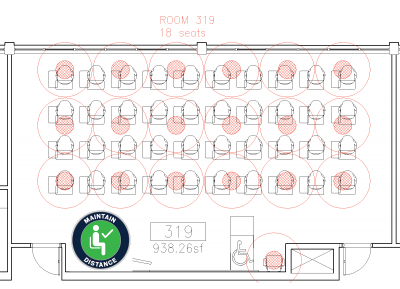
In-Person. A course that will be taught face-to-face in person and scheduled meeting times are required to be listed in PeopleSoft. Social distancing guidelines will require a larger classroom space than previously (e.g. a W section with 19 students will require a classroom size of ~60). This course will be listed as in-person in PeopleSoft.

As instructors develop courses for fall over the summer, the resources available on the eCampus website for the spring will still prove useful. Please be sure to reference . Additionally, more information on public health and sanitization efforts for our campuses can be found at https://reopen.uconn.edu/.

Faculty and staff play an important role in supporting our students as they return in the fall and readjust after months of uncertainty and disruption academically and personally. Students may need more guidance and check-ins than usual from faculty and staff. In particular, graduate students are in the role of both being a student trying to learn in our current environment and supporting our instructional mission.

Beyond instruction, we can also play an important role in encouraging students to follow healthy practices, especially in choosing not to come to class or other campus activities when they are feeling unwell. Students need to know that they will have support in catching up on any material they miss in class or campus work because they have chosen to protect their communities by staying out of the public domain while they are feeling any symptoms of illness.

Most importantly, what doesn’t change is the great strength of UConn’s teaching mission and the true treasure we have in our faculty, graduate students, and staff providing instruction and support. Over the next month, we will balance thoughtful decision-making with prompt communication of updates. In the meantime, we greatly appreciate your patience and all you are doing to support our educational mission.

Thank you,
Carl, John, and Peter

Carl Lejuez
Provost and Executive Vice President for Academic Affairs

John Volin
Vice Provost for Academic Affairs

Peter Diplock
Assistant Vice Provost and Director, Center for Excellence in Teaching and Learning


Updates for the Academic Community

  • Vice Provost for Faculty and Staff Affairs and Development search:Last week we announced the search for the Vice Provost for Faculty and Staff Affairs and Development. Since that time, we have added two faculty members to the search committee who represent our important faculty roles outside of the tenure track. Specifically, we have added Jean McCarthy, who is a Clinical Professor in the Department of Speech, Language and Hearing Sciences, as well as Phil Birge-Liberman, who is an Associate Professor in Residence in the Department of Urban & Community Studies. In addition to their faculty roles, Jean brings considerable experience with AAUP and Phil has considerable experience teaching at multiple regional campuses. More details on the search are available here: https://provost.uconn.edu/administrators-and-leadership/academic-leader-searches/.
  • Tenure clock extension: In light of the disruptions presented by the COVID-19 pandemic and its potential impact on scholarly productivity, the Board of Trustees changed the University By-Laws to provide for a one-year extension to the tenure clock for those tenure-track faculty who request it. Important information regarding the tenure-clock request form, procedures, and FAQs was emailed to Deans and Department Heads at the end of last week, and can also be found on the PTR page on the Provost’s website.
  • Restrictions on students and researchers from China: On May 29, President Trump published a Proclamation on the Suspension of Entry as Nonimmigrants of Certain Students and Researchers from the People’s Republic of China. The proclamation intends to restrict the entry to the United States of students and exchange visitors for study or research if they have connections to any institution that supports China’s “military-civil fusion strategy.” It does not apply to students coming for undergraduate study, to those who are studying or conducting research in a field “involving information that would not contribute to the PRC’s military-civil fusion strategy,” permanent residents of the United States, to someone who is the spouse of a U.S. citizen or lawful permanent resident, and limited other exception categories. The proclamation leaves much of the details to still be worked out among the various government agencies who will need to implement the order, including students and scholars currently in the U.S.  Global Affairs will keep the UConn community informed when there are operational details available from the federal government. For a more detailed analysis, please visit https://isss.uconn.edu/2020/06/01/new-presidential-proclamation-issued/.

Message from President and Provost on Racial Injustice

Dear UConn Community,

Recent events have called national attention yet again to the destructive power of prejudice and racism. The death of George Floyd in police custody in Minneapolis serves as our most recent example. We are disgusted by the images we have seen capturing the unconscionable acts that caused his death. Demonstrations across the country make clear that communities are hurting and frustrated by repeated acts of violence against their neighbors, friends, and families. These events have saddened and angered so many on a deeply personal level, with the burden of fear for one’s own and their family’s safety placed squarely upon African-Americans.

Unfortunately, this is just one of many examples of the pain caused by systemic injustices that are present every day. Take, for example, the disproportionate rates of death by COVID-19 among African-American, Latinx, and Indigenous peoples, or the discriminatory acts targeting individuals of Asian descent and foreign nationals from many countries in this pandemic. This adds to the already vulnerable experience of so many in our community, including but not limited to DACA students who are unsure about their future; individuals with disabilities who can feel invisible; LGBTQ+ individuals experiencing verbal and physical acts of violence; individuals subjected to intolerance based on their religious identity and beliefs; and people of color who are forced to constantly question if they can engage safely in routine activities like jogging or bird watching.

These events underscore the critical importance of our infusing diversity, equity, and inclusion (DEI) in everything we do every single day. Not with mantra and platitudes, but with clearly articulated and tangible action that is supported by the University with budget and action. As scholars, educators, and colleagues, we are uniquely positioned to reflect, learn, and act.

We are committed to this work as UConn moves forward from some of its own recent struggles. We have a crucial new partner in these efforts with the recent hire of Dr. Frank Tuitt as our new Vice President and Chief Diversity Officer. We are all eager to work with him to sustain a culture that understands, respects, and appreciates differences, but also one that readily acknowledges our shortcomings and holds ourselves accountable for measurable progress at all times.

As he looks ahead to this new role, Frank shared the following: “I strongly believe that institutions like UConn should be at the center of creating spaces for students, faculty, and staff to imagine and invent ways to build more inclusive, affirming, and equitable institutions, organizations, and communities, and I look forward to doing my part to contribute to that collective effort.”

We have communicated closely with him over the past several days, and we all will benefit from his leadership and expertise.

We have the opportunity to engage our entire community in the work that is needed, building upon continued advocacy and efforts of concerned faculty, staff, and administrators at UConn in collaboration with our cultural centers and our amazing undergraduate and graduate students who are willing to speak clearly and directly about their experiences. Change cannot be carried out by one person or one office alone. Too often the labor of this work is disproportionately undertaken by our most vulnerable, impacting their career progression, as well as their mental health and overall satisfaction with their work experience. This is a time when we can build momentum to share the responsibility across our entire community at our Storrs, UConn Health, Avery Point, Hartford, Stamford, Waterbury, and law school campuses.

We also have been extremely fortunate to benefit from the stewardship of Interim Chief Diversity Officer Dana Wilder. Building on strengths of the Office for Diversity and Inclusion, we are positioned as a national leader and a place where people of all identities feel they have a genuine opportunity for success and belonging. We encourage each of you to explore their website, which includes multiple resources including trainings and guides as well as information on events and cultural centers sponsored by their office.

There are no simple solutions or easy answers to solve the issues of injustice and prejudice in society and at our University. Of all of the various parts of our experience as administrators, this is the one area where we both feel like we have not done enough or met our own expectations. We do not experience that feeling as despair, but instead as a motivator to understand and accept our own privilege and the responsibilities that it brings to do more. We encourage our community to hold our entire leadership team accountable as we carry out that vital work together.

The challenge now is to remember this moment even if it fades from the headlines and to continue to strive for a society and a UConn that allows all to live safely and welcomed.

Sincerely,
Tom and Carl

Tom Katsouleas
President 

Carl Lejuez
Provost and Executive Vice President for Academic Affairs

Provost’s Message: Advancing UConn Together

Dear UConn Community,

As I begin my tenure as provost at the University of Connecticut this week, I am honored to play a part in building on UConn’s strengths, helping us all navigate current challenges brought on by COVID-19, and positioning us to emerge stronger than ever. At the end of this message, we are sharing the first in a series of COVID-19 updates that are particularly relevant to the academic mission.

My goals align with those of President Katsouleas in supporting life-transformative education, enhancing research, and driving economic growth in the state. I am eager to approach these goals in ways that are relevant to all disciplines within our academic community; prioritize diversity, equity, and inclusion for our faculty, staff, and students; and approach our path forward with a strong interdisciplinary, innovative, and entrepreneurial spirit. Moreover, I look forward to engaging all of our campuses including the Avery Point, Hartford, Stamford, and Waterbury regional campuses.

I have had the privilege of many great conversations over the past few months and what I have learned is central to how I am approaching the role of provost. After extensive discussion, evaluation, and consultation with the exceptionally talented and dedicated team in the Provost’s Office, we have decided to undertake a reorganization to maximize service to our faculty, staff, and students. The change in structure will redistribute responsibilities to enhance depth of focus in critical areas, as well as strengthen our communications infrastructure. I am pleased to share that this reorganization has also benefitted from extensive conversation with stakeholders across campus including the president’s cabinet and our academic deans, as well as leadership from University Senate and the unions.

We have been able to make these changes in a fiscally responsible manner, through targeted efficiencies and realignment of responsibilities, keeping our office lean but also strategically aligned to prioritize the services needed by our community.

The first new role will be focused on organization and communication. Kristi Henderson, who served in a similar combined role with me at the University of Kansas, will be coming to UConn this summer as the assistant vice provost for strategic communications and chief of staff in the Provost’s Office. Kristi will play a pivotal role in the work we will do together as a community to determine and communicate our path forward in the context of an ever-evolving pandemic.

I am also pleased to announce that we will be searching for a new vice provost for faculty/staff affairs and development. This position will be crucial in our ability to balance and focus the portfolios of our existing leadership in the Provost’s Office. In complement to our already strong emphasis on students, this position allows us to prioritize equitable attention to the needs of our faculty and staff. We will announce an internal search for this role in the coming days. With this new position, Vice Provost John Volin will focus his portfolio on undergraduate student success and Vice Provost Jeffrey Shoulson will focus on interdisciplinary and strategic initiatives. The other areas in the Provost’s Office remain unchanged, including graduate education, global affairs, budget, and capital planning, and a committed staff who continue to strive together to maintain excellence in this office.

I am grateful to all those who have welcomed and advised me as I’ve prepared for this new role. I want to especially thank my predecessor, John Elliott, for his leadership this past year, as well as Kathy Slowik, who has steadfastly supported me through a seamless transition before she retires as executive assistant to the provost this August after 20 years in the Provost’s Office.

UConn feels like home already. I am excited to work alongside you as we advance UConn’s mission.

Thank you,
Carl

Carl Lejuez
Provost and Executive Vice President for Academic Affairs


COVID-19 Updates for the Academic Community

  • We are in the process of determining teaching schedules for the Fall and are moving as quickly as possible. We are in regular contact with the Senate Executive Committee and will make sure to prioritize safety and the rigor we’ve come to expect as part of our educational mission. Until we are able to communicate decisions, please continue to follow the guidance from President Katsouleas and prepare for the possibility of your courses being delivered online.
  • The Office of the Vice President for Research (OVPR) has provided new guidance for the phased reopening of research activities in light of the lifting of certain state restrictions. All faculty, post-docs, and students are encouraged to consult the resource page at the following link for important details.
  • Faculty and staff who have the ability to work from home are encouraged to continue to do so until further notice. Please contact your supervisor if you have any questions.
  • Please be sure to follow the daily COVID-19 updates from University Communications, which is your most up to date and comprehensive source of COVID-19 related news and updates.